We are the WordPress Gurus
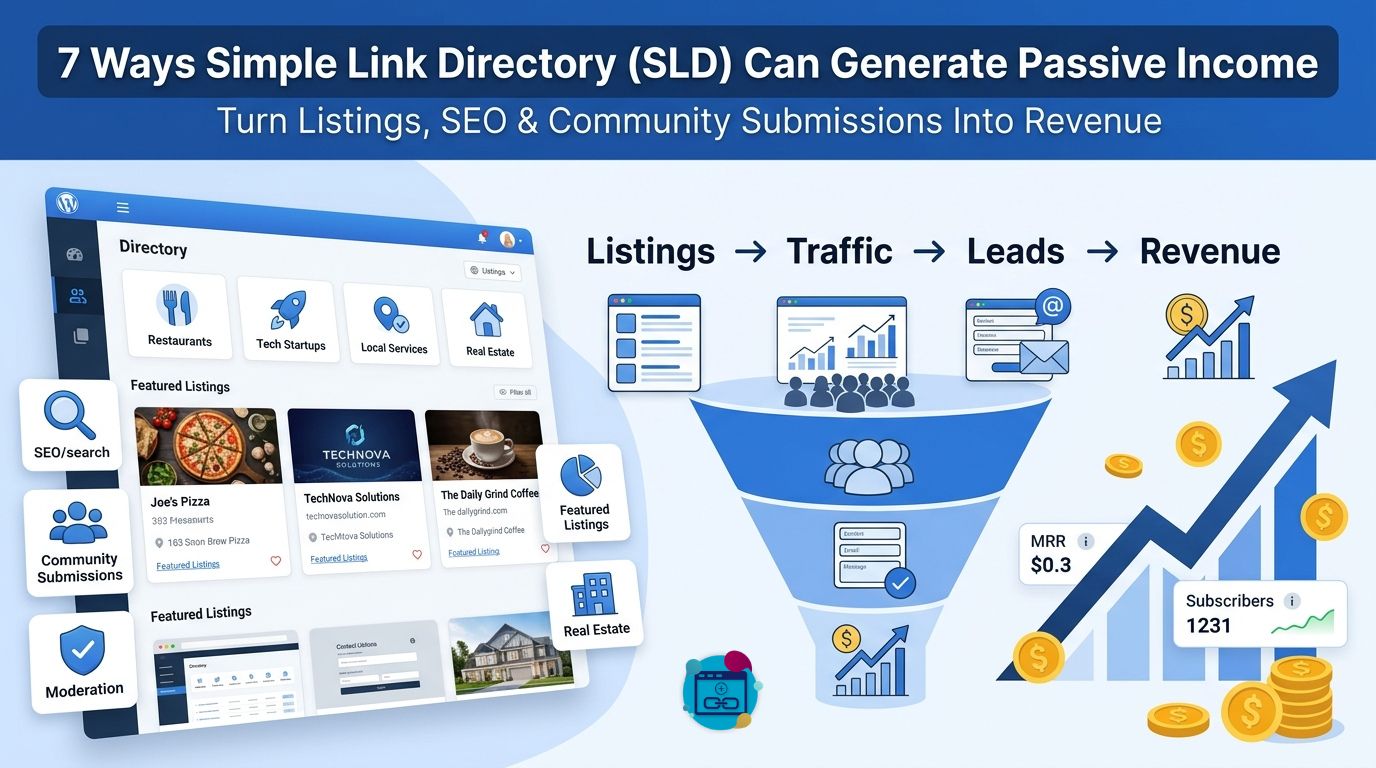
7 Ways Simple Link Directory (SLD) Can Generate Passive Income

Simple Link Directory (SLD) turns a WordPress website into a structured directory where website owners can organize links, categories, listings, submissions, and searchable resources from one central system. Simple Link Directory (SLD) can support passive-income models by combining listing management, paid submissions, community contributions, search visibility, and directory growth without requiring the website owner to manually publish every listing.

Why can Simple Link Directory (SLD) become a passive-income asset?
Simple Link Directory (SLD) can become a passive-income asset because Simple Link Directory (SLD) gives a WordPress site owner a repeatable system for publishing, organizing, moderating, and discovering directory listings.
Simple Link Directory (SLD) creates the strongest passive-income opportunity when the directory solves a specific discovery problem, such as finding local businesses, software tools, agencies, freelancers, educational resources, websites, products, or niche services.
Simple Link Directory (SLD) does not create passive income simply by installing a WordPress plugin. Simple Link Directory (SLD) creates the infrastructure for passive income, while traffic acquisition, niche selection, pricing, listing quality, and monetization strategy determine whether the directory becomes commercially useful.
How does the Simple Link Directory (SLD) passive-income model work?
Simple Link Directory (SLD) can follow a straightforward economic loop: attract visitors → publish useful listings → attract businesses or website owners → monetize listings → reinvest revenue into SEO → increase directory traffic.
Simple Link Directory (SLD) can support a directory with 500 listings, 5,000 listings, or substantially more depending on WordPress hosting resources, database design, taxonomy structure, search configuration, image usage, traffic volume, and moderation requirements.
Simple Link Directory (SLD) can also reduce repetitive publishing work because structured listings allow a directory owner to standardize fields such as business name, website URL, category, description, location, contact information, and other directory-specific data.
1. How can Simple Link Directory (SLD) make money from paid listings?
Simple Link Directory (SLD) can generate recurring revenue by allowing a directory owner to charge businesses or website owners for publishing listings.
Simple Link Directory (SLD) works particularly well for paid-directory models when the directory has a clearly defined audience and provides genuine discovery value instead of functioning as a random collection of links.
Simple Link Directory (SLD) can support several paid-listing structures, including one-time listing fees, recurring subscriptions, featured placement fees, premium category placement, sponsored listings, and upgraded visibility packages.
Which paid-listing model can Simple Link Directory (SLD) support best?
Simple Link Directory (SLD) can be used with a simple pricing structure such as $20 for a standard listing, $49 for a featured listing, and $99 for a premium placement, depending on the directory niche and audience value.
Simple Link Directory (SLD) can produce meaningful revenue even with relatively small numbers when listing prices match the commercial value of directory traffic.
| Simple Link Directory (SLD) Revenue Model | Example Price | 10 Monthly Sales | 100 Monthly Sales |
| Simple Link Directory (SLD) Standard Listing | $20 | $200 | $2,000 |
| Simple Link Directory (SLD) Featured Listing | $49 | $490 | $4,900 |
| Simple Link Directory (SLD) Premium Placement | $99 | $990 | $9,900 |
| Simple Link Directory (SLD) Annual Listing | $199 | $1,990 | $19,900 |
Simple Link Directory (SLD) revenue calculations should always be treated as scenario models rather than guaranteed earnings because actual conversion rates depend on traffic, niche demand, pricing, listing quality, and sales execution.
Why can Simple Link Directory (SLD) paid listings become semi-passive?
Simple Link Directory (SLD) can make paid listings semi-passive when the listing workflow is standardized and payment, submission, approval, notification, and publishing processes require minimal manual intervention.
Simple Link Directory (SLD) can reduce administrative workload by giving directory owners structured listing management instead of forcing every business entry into an individually designed WordPress page.
Simple Link Directory (SLD) becomes more scalable when the directory owner spends time improving the system rather than manually formatting every new listing.
2. How can Simple Link Directory (SLD) monetize featured listings?
Simple Link Directory (SLD) can create a second revenue stream by selling additional visibility to businesses that already have standard listings.
Simple Link Directory (SLD) can turn a basic directory entry into a tiered advertising product where businesses pay for better placement, enhanced exposure, category prominence, or other premium visibility options supported by the overall directory setup.
Why would businesses pay for Simple Link Directory (SLD) featured placement?
Simple Link Directory (SLD) featured placement becomes commercially attractive when directory visitors have strong purchase or hiring intent.
Simple Link Directory (SLD) can be more valuable to a local plumber directory, wedding vendor directory, legal-service directory, marketing-agency directory, or software directory than to a generic website list because commercial intent can increase the value of each visitor.
Simple Link Directory (SLD) can create a simple three-tier structure:
- Simple Link Directory (SLD) Free Listing: Basic business or website information.
- Simple Link Directory (SLD) Featured Listing: Enhanced visibility within a relevant category.
- Simple Link Directory (SLD) Premium Listing: Maximum exposure with additional promotional benefits.
Simple Link Directory (SLD) can use a $29 monthly featured placement model as a hypothetical example, where 30 paying businesses would produce $870 in monthly recurring revenue before transaction fees, taxes, refunds, or other operating costs.
Simple Link Directory (SLD) can use annual packages to reduce payment frequency and increase revenue predictability, such as a hypothetical $299 annual featured placement package.
How does Simple Link Directory (SLD) improve the economics of featured listings?
Simple Link Directory (SLD) improves the economics of featured listings when the directory owner creates measurable value around visibility instead of simply labeling one listing as “featured.”
Simple Link Directory (SLD) can support a stronger commercial proposition when premium listings receive access to high-traffic category pages, relevant search pages, curated collections, or other valuable directory locations.
3. How can Simple Link Directory (SLD) turn community submissions into recurring revenue?
Simple Link Directory (SLD) can allow a directory owner to build a submission-based business model where businesses, creators, agencies, developers, or website owners submit their own listings.
Simple Link Directory (SLD) can reduce content acquisition costs because businesses contribute listing information instead of the directory owner manually researching every company.
Simple Link Directory (SLD) becomes especially interesting for niche directories because every accepted submission can expand the directory’s searchable inventory.
Why are community submissions important for Simple Link Directory (SLD)?
Simple Link Directory (SLD) community submissions can create a scalable supply-side engine for directory growth.
Simple Link Directory (SLD) can transform a directory from a manually maintained resource into a marketplace-like discovery database where listing owners have a reason to contribute information.
Simple Link Directory (SLD) can support a workflow where a business submits a listing, the listing enters moderation, the directory administrator reviews the information, and the approved listing becomes publicly discoverable.
How can Simple Link Directory (SLD) monetize community submissions?
Simple Link Directory (SLD) can monetize community submissions through submission fees, premium submission packages, featured upgrades, recurring listing plans, or paid verification services when the surrounding WordPress implementation supports those commercial workflows.
Simple Link Directory (SLD) can use a hypothetical $25 submission fee with 40 approved paid submissions per month to produce $1,000 in monthly gross submission revenue.
Simple Link Directory (SLD) can increase average revenue per customer by combining a $25 standard submission with optional $50 or $100 visibility upgrades.
4. How can Simple Link Directory (SLD) protect directory quality with moderation?
Simple Link Directory (SLD) needs moderation because passive-income directories can quickly become difficult to manage when open submissions attract spam, duplicate listings, low-quality websites, misleading descriptions, broken URLs, or inappropriate content.
Simple Link Directory (SLD) moderation can protect the directory’s search quality and commercial reputation by keeping low-quality submissions away from public pages.
What should Simple Link Directory (SLD) moderation check?
Simple Link Directory (SLD) moderation should check listing relevance, URL validity, duplicate content, category accuracy, business identity, promotional language, suspicious links, and overall usefulness.
Simple Link Directory (SLD) moderation should apply consistent rules so paid customers receive predictable treatment and free contributors cannot overwhelm the directory with low-quality submissions.
Simple Link Directory (SLD) can use a practical moderation checklist:
- Simple Link Directory (SLD) URL validation: Confirm that submitted URLs resolve correctly.
- Simple Link Directory (SLD) duplicate detection: Check whether the same business or website already exists.
- Simple Link Directory (SLD) category validation: Confirm that the listing belongs in the selected category.
- Simple Link Directory (SLD) content review: Remove thin, misleading, or spam-heavy descriptions.
- Simple Link Directory (SLD) commercial review: Verify that paid placements follow published pricing rules.
- Simple Link Directory (SLD) security review: Reject suspicious URLs, scripts, or potentially harmful submission content.
How does Simple Link Directory (SLD) make moderation scalable?
Simple Link Directory (SLD) can make moderation more scalable when directory rules are defined before the directory reaches hundreds or thousands of submissions.
Simple Link Directory (SLD) can reduce manual work when administrators use structured fields and repeatable approval criteria instead of reviewing every listing as an entirely different content type.
Simple Link Directory (SLD) can support a “moderate once, benefit repeatedly” approach where a high-quality listing remains useful in category pages and search results long after the initial approval.
5. How can Simple Link Directory (SLD) generate affiliate revenue?
Simple Link Directory (SLD) can support affiliate-income opportunities when directory listings connect visitors with products, services, software, hosting companies, courses, tools, travel services, or other commercially relevant offers.
Simple Link Directory (SLD) affiliate revenue works best when the directory provides genuine comparison or discovery value instead of creating thin affiliate pages.
How can Simple Link Directory (SLD) turn outbound discovery into affiliate income?
Simple Link Directory (SLD) can organize affiliate resources into categories that help visitors compare solutions before clicking through to external websites.
Simple Link Directory (SLD) can create niche resource directories such as WordPress tools, SaaS products, marketing software, business services, educational platforms, or professional resources.
Simple Link Directory (SLD) can use a hypothetical example where 10,000 monthly directory visitors generate a 5% outbound click rate, producing 500 affiliate clicks.
Simple Link Directory (SLD) can generate $2,000 in monthly affiliate revenue in a hypothetical scenario if 500 clicks produce 40 conversions and the average affiliate commission equals $50.
Simple Link Directory (SLD) affiliate calculations should always be treated as planning examples because affiliate conversion rates, commission values, cookie windows, merchant policies, and visitor intent vary substantially.
Why does Simple Link Directory (SLD) work well for affiliate discovery?
Simple Link Directory (SLD) works well for affiliate discovery because structured directories naturally organize many related commercial resources into searchable categories.
Simple Link Directory (SLD) can create long-tail discovery pages around specific categories, locations, industries, technologies, use cases, or professional requirements.
6. How can Simple Link Directory (SLD) use SEO to create compounding traffic?
Simple Link Directory (SLD) can support a powerful passive-income loop because directory listings can create many useful discovery opportunities when categories and listing content are properly structured.
Simple Link Directory (SLD) SEO performance depends on content quality, search intent, internal linking, crawlability, page uniqueness, technical performance, authority, and competition rather than the directory plugin alone.
Why can Simple Link Directory (SLD) create long-tail SEO opportunities?
Simple Link Directory (SLD) can create structured pages around combinations such as category + location, service + location, tool + use case, industry + provider, or resource + audience.
Simple Link Directory (SLD) can turn a single broad topic into many highly specific discovery paths when directory taxonomy reflects real user search behavior.
Simple Link Directory (SLD) should avoid automatically generating thousands of nearly identical pages because low-value programmatic pages can create crawl waste and weak search experiences.
How should Simple Link Directory (SLD) structure directory SEO?
Simple Link Directory (SLD) SEO architecture should use clear categories, meaningful listing titles, useful descriptions, descriptive URLs, relevant internal links, and indexable pages that satisfy identifiable search intent.
Simple Link Directory (SLD) category architecture should remain shallow enough for search engines and users to understand while remaining detailed enough to separate genuinely different search intents.
Simple Link Directory (SLD) can use a structure such as:
/directory/marketing-agencies/
/directory/marketing-agencies/dhaka/
/directory/marketing-agencies/dhaka/agency-name/
Simple Link Directory (SLD) should only create location or subcategory pages when sufficient unique listings and useful information exist to justify separate pages.
How does Simple Link Directory (SLD) turn SEO traffic into passive income?
Simple Link Directory (SLD) can monetize organic traffic through paid listings, featured placements, affiliate clicks, advertising, sponsorships, lead-generation partnerships, or premium directory access.
Simple Link Directory (SLD) creates stronger economics when one SEO page can generate traffic repeatedly without requiring a new advertising campaign for every visitor.
Simple Link Directory (SLD) can therefore create a compounding model where SEO investment produces traffic, traffic increases listing value, listing value attracts paying businesses, and paying businesses provide revenue that can fund further content and SEO improvements.
7. How can Simple Link Directory (SLD) grow into a directory business that needs less daily work?
Simple Link Directory (SLD) can become more passive when directory operations are designed as repeatable workflows instead of manual one-off tasks.
Simple Link Directory (SLD) growth should begin with one focused niche rather than an enormous general directory containing unrelated websites.
Which niche strategy works best for Simple Link Directory (SLD)?
Simple Link Directory (SLD) can benefit from niches where businesses already spend money to acquire customers and where users actively search for providers.
Simple Link Directory (SLD) can target directories such as:
- Simple Link Directory (SLD) Local Business Directory: Businesses organized by city, service, and location.
- Simple Link Directory (SLD) Software Directory: SaaS products organized by business problem or use case.
- Simple Link Directory (SLD) Agency Directory: Marketing, development, SEO, design, and consulting agencies.
- Simple Link Directory (SLD) Education Directory: Schools, courses, tutors, training centers, and educational resources.
- Simple Link Directory (SLD) Professional Directory: Freelancers, consultants, lawyers, accountants, or specialized professionals.
- Simple Link Directory (SLD) Resource Directory: Useful websites, tools, publications, communities, and online resources.
How can Simple Link Directory (SLD) create a realistic passive-income funnel?
Simple Link Directory (SLD) can use the following funnel as a practical operating model:
Simple Link Directory (SLD) SEO page → Simple Link Directory (SLD) visitor → Simple Link Directory (SLD) listing discovery → Simple Link Directory (SLD) business exposure → Simple Link Directory (SLD) paid upgrade.
Simple Link Directory (SLD) can add a second funnel:
Simple Link Directory (SLD) SEO page → Simple Link Directory (SLD) visitor → Simple Link Directory (SLD) external product click → Simple Link Directory (SLD) affiliate conversion.
Simple Link Directory (SLD) can add a third funnel:
Simple Link Directory (SLD) category page → Simple Link Directory (SLD) business owner → Simple Link Directory (SLD) submission → Simple Link Directory (SLD) paid listing.
What does a realistic Simple Link Directory (SLD) revenue model look like?
Simple Link Directory (SLD) can combine several modest revenue sources rather than depending on one aggressive monetization channel.
| Simple Link Directory (SLD) Revenue Source | Example Monthly Volume | Example Unit Revenue | Example Gross Revenue |
| Simple Link Directory (SLD) Paid Listings | 20 | $25 | $500 |
| Simple Link Directory (SLD) Featured Upgrades | 10 | $50 | $500 |
| Simple Link Directory (SLD) Affiliate Conversions | 15 | $35 | $525 |
| Simple Link Directory (SLD) Sponsorships | 2 | $150 | $300 |
| Simple Link Directory (SLD) Total Scenario | — | — | $1,825 |
Simple Link Directory (SLD) revenue scenarios should not be interpreted as guaranteed income because the actual result depends on directory traffic, buyer intent, niche economics, pricing, conversion rates, and operating expenses.
Simple Link Directory (SLD) can become substantially more attractive when recurring revenue grows while marginal listing-management costs remain relatively low.
How can Simple Link Directory (SLD) turn 1,000 listings into a stronger SEO asset?
Simple Link Directory (SLD) can turn a large listing inventory into a stronger discovery asset when every listing contains useful, differentiated information.
Simple Link Directory (SLD) should not treat listing quantity as the primary SEO goal because 1,000 low-value listings can be less useful than 200 genuinely valuable listings.
Simple Link Directory (SLD) directory owners should prioritize listing completeness, category accuracy, unique descriptions, trustworthy outbound links, relevant taxonomy, and user usefulness.
What should every Simple Link Directory (SLD) listing contain?
Simple Link Directory (SLD) listings can contain a descriptive title, useful summary, website URL, category, location, contact details, relevant attributes, and other structured fields appropriate for the directory niche.
Simple Link Directory (SLD) listing templates should make important information easy for both visitors and search engines to understand.
How can Simple Link Directory (SLD) combine all seven income streams?
Simple Link Directory (SLD) becomes more commercially powerful when paid listings, featured placements, community submissions, affiliate revenue, sponsorships, and SEO traffic operate as connected parts of one directory ecosystem.
Simple Link Directory (SLD) can use the following business architecture:
| Simple Link Directory (SLD) Layer | Primary Function | Potential Monetization |
| Simple Link Directory (SLD) Listing Management | Organize directory inventory | Paid listings |
| Simple Link Directory (SLD) Community Submissions | Acquire new listings | Submission fees |
| Simple Link Directory (SLD) Moderation | Protect quality | Premium approval |
| Simple Link Directory (SLD) Featured Listings | Increase business visibility | Featured-placement fees |
| Simple Link Directory (SLD) SEO Discovery | Attract organic visitors | Affiliate revenue |
| Simple Link Directory (SLD) Directory Growth | Increase inventory and authority | Sponsorships |
| Simple Link Directory (SLD) Structured Discovery | Help visitors find resources | Lead-generation revenue |
Simple Link Directory (SLD) can therefore function as the operational layer behind a directory business rather than merely acting as a collection of links.
What technical setup gives Simple Link Directory (SLD) the best chance of generating passive income?
Simple Link Directory (SLD) should run on WordPress hosting with enough CPU, memory, database performance, storage, and bandwidth for the expected number of listings and visitors.
Simple Link Directory (SLD) performance should be measured under realistic conditions because a directory containing 10,000 listings and receiving 100,000 monthly visitors has very different infrastructure requirements from a directory containing 500 listings and receiving 5,000 monthly visitors.
Simple Link Directory (SLD) directories should use caching, optimized images, efficient database queries, sensible pagination, CDN delivery where appropriate, and careful plugin selection.
What should Simple Link Directory (SLD) owners monitor?
Simple Link Directory (SLD) owners should monitor organic traffic, indexed URLs, listing submissions, approval rates, paid conversion rates, featured-listing revenue, affiliate clicks, broken URLs, database size, server response time, and search performance.
Simple Link Directory (SLD) owners can calculate customer acquisition economics with a simple formula:
Simple Link Directory (SLD) Customer Acquisition Cost = Total Marketing Spend ÷ Number of New Paying Listings
Simple Link Directory (SLD) owners can calculate listing lifetime value with:
Simple Link Directory (SLD) Listing LTV = Average Monthly Listing Revenue × Average Customer Lifetime in Months
Simple Link Directory (SLD) owners can evaluate passive-income potential by comparing listing LTV against acquisition cost, payment fees, hosting expenses, moderation labor, content costs, and software costs.
How should Simple Link Directory (SLD) avoid the biggest passive-income mistake?
Simple Link Directory (SLD) directory owners should avoid assuming that installing a directory plugin automatically creates traffic or revenue.
Simple Link Directory (SLD) requires a valuable niche, useful listings, strong information architecture, consistent moderation, search-focused content, and a monetization strategy aligned with visitor intent.
Simple Link Directory (SLD) should also avoid accepting every community submission simply to increase listing numbers because poor-quality listings can reduce user trust and weaken the overall directory experience.
What are the five hardest technical objections developers may have about Simple Link Directory (SLD)?
Can Simple Link Directory (SLD) create significant server-resource overhead?
Simple Link Directory (SLD) resource usage depends on directory size, database queries, search behavior, traffic volume, image processing, caching configuration, WordPress hosting, and the number of other active plugins.
Simple Link Directory (SLD) directories with thousands of listings should use properly configured object caching, page caching, optimized database indexes where applicable, efficient pagination, and production-grade hosting rather than relying on extremely limited shared hosting.
Simple Link Directory (SLD) performance testing should measure PHP execution time, database query time, memory consumption, TTFB, cache-hit rates, concurrent requests, and peak traffic behavior.
Simple Link Directory (SLD) administrators should investigate slow queries and excessive uncached search requests before assuming that directory functionality itself is responsible for every performance problem.
How should Simple Link Directory (SLD) manage OpenAI, Gemini, and DeepSeek API token billing?
Simple Link Directory (SLD) installations that connect external AI services through custom integrations or supporting WordPress components should treat API usage as a metered infrastructure expense rather than as unlimited functionality.
Simple Link Directory (SLD) administrators should separate AI credentials by environment, restrict API keys where the provider supports restrictions, monitor token consumption, establish provider-side spending limits where available, and avoid exposing API keys in browser-side JavaScript.
Simple Link Directory (SLD) administrators should estimate AI operating cost using:
Simple Link Directory (SLD) AI Cost = Input Tokens × Input Rate + Output Tokens × Output Rate + Additional Provider Charges
Simple Link Directory (SLD) administrators should also cache repeated AI responses when the underlying use case permits caching because repeated identical requests can otherwise produce unnecessary token consumption.
Simple Link Directory (SLD) does not inherently guarantee a particular OpenAI, Gemini, or DeepSeek billing model, so developers should verify current provider pricing, quotas, API terms, and integration requirements before deploying an AI-assisted directory workflow.
How should Simple Link Directory (SLD) handle GDPR and directory privacy requirements?
Simple Link Directory (SLD) directory owners should distinguish between publicly required listing information and personally identifiable information collected during submissions.
Simple Link Directory (SLD) installations collecting names, email addresses, phone numbers, IP addresses, user accounts, submission metadata, or other personal information should document why each data field exists and how each data field is processed.
Simple Link Directory (SLD) privacy architecture should minimize unnecessary personal-data collection, define retention periods, restrict administrator access, protect stored credentials, and provide appropriate privacy disclosures.
Simple Link Directory (SLD) administrators should also review third-party integrations because submitted information can leave the WordPress installation when payment processors, email services, analytics systems, CRMs, webhooks, or external APIs are involved.
Simple Link Directory (SLD) should be deployed as part of a broader GDPR-compliant WordPress architecture rather than being treated as a standalone GDPR compliance solution.
How should developers evaluate Simple Link Directory (SLD) after historical security patches or vulnerabilities?
Simple Link Directory (SLD) developers should evaluate security history using official plugin release notes, WordPress.org records, vendor security advisories, vulnerability databases, and current changelogs rather than relying on outdated forum discussions.
Simple Link Directory (SLD) administrators should keep the active production version updated because security patches generally depend on deploying the corrected release rather than merely reviewing the historical vulnerability.
Simple Link Directory (SLD) installations should use strong administrator credentials, least-privilege WordPress roles, HTTPS, reliable backups, malware monitoring, security logging, and controlled plugin installation policies.
Simple Link Directory (SLD) developers should also test updates in staging environments before production deployment when a directory contains substantial commercial data or receives high traffic.
Simple Link Directory (SLD) security assessment should focus on the current version, current dependencies, current WordPress environment, custom code, integrations, and configuration rather than assuming that a historical vulnerability represents the security state of every current release.
Is Simple Link Directory (SLD) actually capable of creating passive income?
Simple Link Directory (SLD) can provide the technical foundation for a passive-income directory, but Simple Link Directory (SLD) cannot guarantee revenue without traffic, demand, quality listings, monetization, and ongoing optimization.
Simple Link Directory (SLD) offers the strongest opportunity when a directory targets a narrow commercial niche where businesses benefit from visibility and visitors benefit from structured discovery.
Simple Link Directory (SLD) can combine seven practical income paths: paid listings, featured placements, community submission fees, affiliate revenue, sponsorships, SEO-driven traffic monetization, and scalable directory growth.
Simple Link Directory (SLD) becomes more passive as automation, moderation rules, SEO systems, payment workflows, and listing templates reduce repetitive administrative work.
Simple Link Directory (SLD) ultimately works best when the directory owner treats the directory as a digital asset rather than simply as a WordPress page containing links: useful listings attract visitors, visitors create commercial value, commercial value attracts paying listing owners, and revenue funds the next stage of directory growth.
FAQ’s
What is Simple Link Directory (SLD) and what does it offer?
Simple Link Directory (SLD) turns a WordPress website into a structured directory where website owners can organize links, categories, listings, submissions, and searchable resources from one central system.
Why can Simple Link Directory (SLD) become a passive-income asset?
Simple Link Directory (SLD) can become a passive-income asset because it provides website owners with a repeatable system for publishing, organizing, moderating, and discovering directory listings.
How does the Simple Link Directory (SLD) passive-income model work?
The Simple Link Directory (SLD) passive-income model follows a straightforward economic loop: attract visitors → publish useful listings → attract businesses or website owners → monetize listings → reinvest revenue into SEO → increase directory traffic.
How can Simple Link Directory (SLD) make money from paid listings?
Simple Link Directory (SLD) can generate recurring revenue by allowing a directory owner to charge businesses or website owners for publishing listings.
Which paid-listing model can Simple Link Directory (SLD) support best?
Simple Link Directory (SLD) can support a simple pricing structure such as $20 for a standard listing, $49 for a featured listing, and $99 for a premium placement, depending on the directory niche and audience value.
How can Simple Link Directory (SLD) turn community submissions into recurring revenue?
Simple Link Directory (SLD) can allow a directory owner to build a submission-based business model where businesses, creators, agencies, developers, or website owners submit their own listings.
How can Simple Link Directory (SLD) protect directory quality with moderation?
Simple Link Directory (SLD) needs moderation to protect the directory's search quality and commercial reputation by keeping low-quality submissions away from public pages.
Is Simple Link Directory (SLD) actually capable of creating passive income?
Simple Link Directory (SLD) can provide the technical foundation for a passive-income directory, but cannot guarantee revenue without traffic, demand, quality listings, monetization, and ongoing optimization.