We are the WordPress Gurus
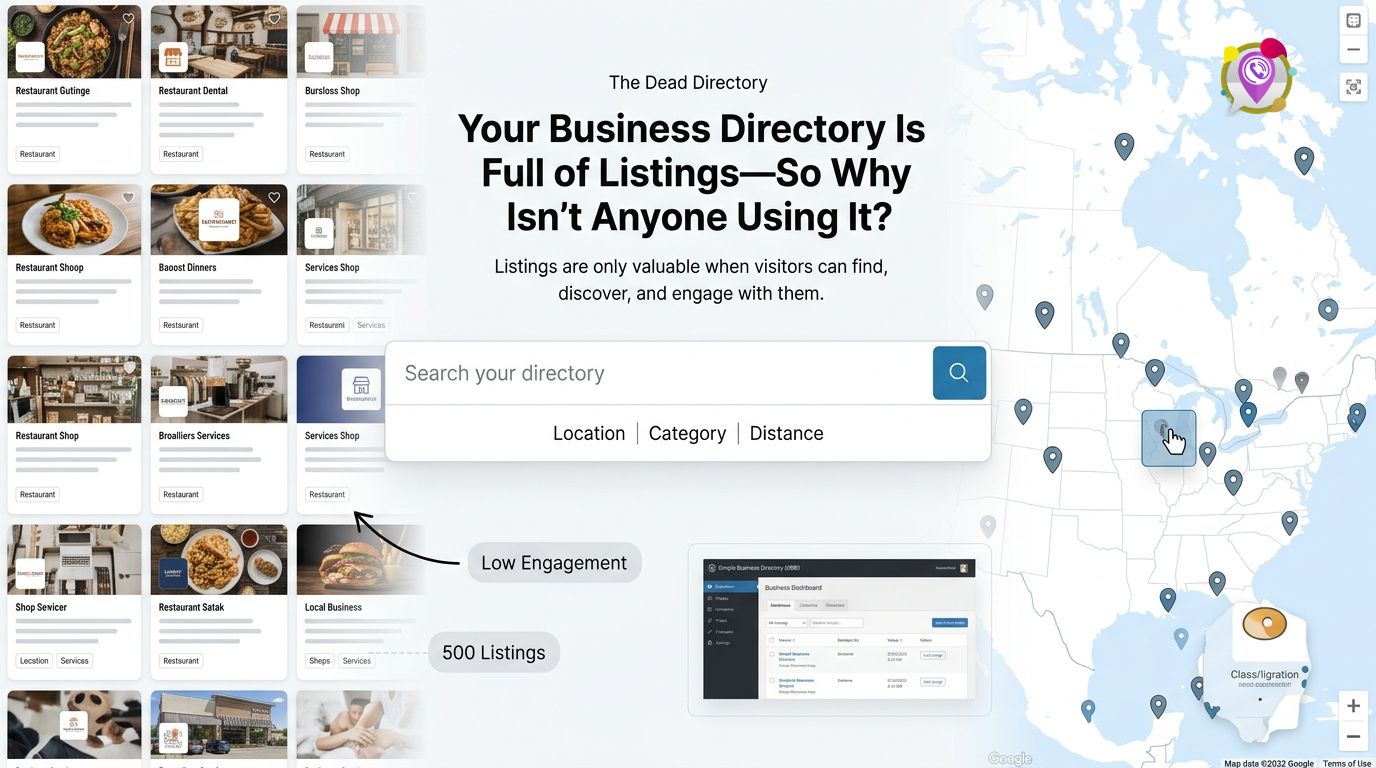
Your Business Directory Is Full of Listings—So Why Isn’t Anyone Using It?

Simple Business Directory (SBD) helps WordPress site owners build searchable business directories by organizing business listings into lists, adding maps or OpenStreetMap, enabling instant search and filtering, and supporting user-facing discovery features such as bookmarks, upvotes, submissions, and embeds.
Simple Business Directory (SBD) also connects directory management with AI-assisted content generation, community submissions, paid listings, claim listings, and embeddable directory content, giving WordPress site owners a practical foundation for building a directory that can attract visitors, generate engagement, and create revenue opportunities.

Why Does Simple Business Directory (SBD) Have Hundreds of Listings but Almost No Real Usage?
A directory can contain 500 businesses and still feel completely useless.
Simple Business Directory (SBD) solves a different problem from simply storing business names because Simple Business Directory (SBD) gives directory owners tools for organizing listings, searching listings, filtering listings, locating businesses, bookmarking businesses, and encouraging users to interact with listings.
A directory visitor usually arrives with a specific task.
A visitor may want “Italian restaurants near me,” “WordPress agencies in London,” “wedding photographers in Dhaka,” “software companies in New York,” or “employees in the sales department.”
Simple Business Directory (SBD) becomes more useful when every directory listing helps answer the visitor’s actual search instead of forcing the visitor to scroll through a giant alphabetical list.
The difference is simple:
| Weak Directory | Simple Business Directory (SBD) Approach |
| Simple Business Directory (SBD) listing pages can become difficult to navigate when information lacks structure | Simple Business Directory (SBD) supports lists, categories, tags, search, and filtering |
| Visitors manually scan listings | Simple Business Directory (SBD) provides instant search and filtering |
| Location information remains buried in text | Simple Business Directory (SBD) can connect listings with Google Maps or OpenStreetMap |
| Directory owners manually create every listing | Simple Business Directory (SBD) provides AI-assisted generation and frontend submissions |
| Listings remain isolated | Simple Business Directory (SBD) supports bookmarks, upvotes, sharing, and embeds |
| Directory owners depend only on advertising | Simple Business Directory (SBD) supports free and paid listing opportunities |
The core lesson is important: Simple Business Directory (SBD) should be treated as a discovery system, not merely a database of business names.
Directory Management & Business Listings: Why Are Your Listings Harder to Manage Than Your Business?

Why Does Simple Business Directory (SBD) Need a Better Listing Structure?
Simple Business Directory (SBD) uses lists as a core organizational building block, allowing directory owners to create multiple groups of related business listings and display individual lists or collections of lists across WordPress pages.
Simple Business Directory (SBD) can therefore support a local restaurant directory, staff directory, company directory, vendor directory, store locator, partner directory, employee directory, or niche business directory without requiring every directory project to follow the same structure.
A practical directory might use the following structure:
- Simple Business Directory (SBD) can organize restaurants by cuisine, location, price range, or service type.
- Simple Business Directory (SBD) can organize agencies by marketing specialty, city, industry, or service.
- Simple Business Directory (SBD) can organize employees by department, role, office, or team.
- Simple Business Directory (SBD) can organize retailers by location, product category, or territory.
- Simple Business Directory (SBD) can organize vendors by service category, geographic region, or business type.
The structure matters because directory visitors rarely search for “all businesses.”
Directory visitors usually search for one useful subset of businesses.
How Can Simple Business Directory (SBD) Stop a Directory From Becoming a Data Dump?
Simple Business Directory (SBD) supports fields such as business names, links, descriptions, social profiles, location information, images, tags, and other listing details, allowing directory owners to create richer business profiles rather than publishing only names and URLs.
Simple Business Directory (SBD) also supports address-based latitude and longitude generation for map-oriented listings, reducing manual geographic data entry during directory creation.
A useful listing should answer several questions immediately:
- Simple Business Directory (SBD) should make the business name obvious.
- Simple Business Directory (SBD) should make the business category understandable.
- Simple Business Directory (SBD) should make the business location discoverable.
- Simple Business Directory (SBD) should make the business website or contact path accessible.
- Simple Business Directory (SBD) should provide enough description for visitors to understand relevance.
- Simple Business Directory (SBD) should provide visual information when images improve decision-making.
- Simple Business Directory (SBD) should give visitors useful actions instead of forcing passive browsing.
The goal is not maximum information.
The goal is maximum useful information per listing.
Why Can Simple Business Directory (SBD) AI Generation Save Hours of Directory Work?
Simple Business Directory (SBD) includes AI-assisted business list generation using supported AI providers including Gemini, OpenAI, and OpenRouter.
Simple Business Directory (SBD) can use AI assistance to generate business names, locations, titles, subtitles, images, and longer descriptions, helping directory owners accelerate the initial content-building process.
Consider a directory project requiring 300 draft listings.
If manual preparation requires an average of 8 minutes per listing, the calculation becomes:
300 listings × 8 minutes = 2,400 minutes
2,400 minutes ÷ 60 = 40 hours
Simple Business Directory (SBD) AI-assisted generation can reduce repetitive content preparation, although every AI-generated listing should still be reviewed for accuracy before publication.
The important distinction is that Simple Business Directory (SBD) AI generation should accelerate directory production, not replace editorial verification.
How Can Simple Business Directory (SBD) Handle User-Submitted Business Listings?
Simple Business Directory (SBD) supports frontend registration, login, dashboards, and user-submitted listings, allowing directory owners to move part of listing collection from administrator-only workflows toward community participation.
Simple Business Directory (SBD) can therefore support a directory model where business owners submit information instead of sending every update through email.
A practical workflow looks like this:
- Simple Business Directory (SBD) lets a business owner register through the frontend.
- Simple Business Directory (SBD) lets a registered user access a frontend dashboard.
- Simple Business Directory (SBD) lets the user submit business information.
- Simple Business Directory (SBD) gives the directory administrator control over submitted content.
- Simple Business Directory (SBD) can support paid submission packages for monetized directories.
The workflow creates a useful incentive: business owners can contribute the data that benefits business owners.
User Discovery & Engagement: Why Are Visitors Leaving Before Finding a Business?

Why Does Simple Business Directory (SBD) Need Instant Search?
Simple Business Directory (SBD) supports live, on-page instant search, allowing visitors to narrow directory content without relying entirely on browser scrolling.
Imagine a directory containing 400 businesses.
A visitor searching for “dentist” should not need to manually scan 400 entries.
Simple Business Directory (SBD) can reduce the interaction cost by allowing visitors to search the directory directly.
The same principle applies to large directories containing 50, 500, or significantly more listings.
Search becomes especially valuable when Simple Business Directory (SBD) is used for niche directories where users already know approximately what category or business name the user wants.
How Can Simple Business Directory (SBD) Make Filtering More Useful Than Search Alone?
Search answers “What am I looking for?”
Filtering answers “Which version of what I want?”
Simple Business Directory (SBD) supports instant filtering and tag-based filtering, giving directory owners another layer for organizing large collections of listings.
For example:
- Simple Business Directory (SBD) can filter restaurants by cuisine tags.
- Simple Business Directory (SBD) can filter agencies by service tags.
- Simple Business Directory (SBD) can filter companies by industry tags.
- Simple Business Directory (SBD) can filter locations by geographic categories.
- Simple Business Directory (SBD) can filter staff directories by departments or organizational categories.
A directory becomes much more useful when search and filtering work together.
Why Can Simple Business Directory (SBD) Maps Change the Way Visitors Discover Businesses?
Simple Business Directory (SBD) supports Google Maps and OpenStreetMap, allowing directory owners to present geographic information alongside business listings.
Location can be the primary decision factor for many directories.
A restaurant directory visitor may care more about distance than restaurant name.
A store locator visitor may care more about nearby availability than company description.
A dealer directory visitor may care more about regional coverage than business history.
Simple Business Directory (SBD) supports location-oriented directory use cases through maps, address information, geolocation features, and distance-search capabilities in the appropriate version or configuration.
Simple Business Directory (SBD) also supports OpenStreetMap, giving directory owners an option that does not require the same Google Maps setup.
How Can Simple Business Directory (SBD) Turn Passive Visitors Into Active Users?
A directory becomes stronger when visitors interact with listings.
Simple Business Directory (SBD) supports user upvotes, favorites or bookmarks, sharing, and embedding capabilities that can turn directory browsing into repeat interaction.
Useful engagement mechanisms include:
- Simple Business Directory (SBD) upvotes can create a lightweight popularity signal.
- Simple Business Directory (SBD) favorites can help users save useful listings for later.
- Simple Business Directory (SBD) embeds can allow other websites to display curated directory content.
- Simple Business Directory (SBD) sharing can extend directory exposure beyond the original website.
- Simple Business Directory (SBD) frontend submissions can give businesses a reason to participate.
The engagement loop becomes:
Discover → Compare → Save → Share → Return → Recommend
Simple Business Directory (SBD) supports multiple stages of that loop.
Can Simple Business Directory (SBD) Embeds Generate More Than Traffic?
Simple Business Directory (SBD) allows curated lists to be embedded on other websites, creating a distribution mechanism beyond the original directory page.
Imagine a local business association creates a directory of 200 members.
Five participating websites embed relevant sections.
The original directory gains additional exposure because the directory content appears in multiple locations.
Simple Business Directory (SBD) documentation also describes embedded directory listings as an opportunity for backlinks when other websites publish curated directory content.
Backlinks should never be treated as guaranteed SEO outcomes, but relevant embeds can create genuine referral pathways when other website owners choose to publish useful directory information.
SEO, Growth & Monetization: Why Does a Useful Directory Still Need a Growth Engine?

How Can Simple Business Directory (SBD) Turn Directory Listings Into Search-Focused Content?
Simple Business Directory (SBD) can help directory owners organize listings around specific categories, locations, services, and business types.
That structure can support an SEO content strategy.
Instead of publishing one generic page called:
“Business Directory”
a directory owner could create useful topical structures around:
- Simple Business Directory (SBD) can support a “Best Web Agencies in Dhaka” directory concept.
- Simple Business Directory (SBD) can support a “Restaurants in Dhanmondi” directory concept.
- Simple Business Directory (SBD) can support a “WordPress Developers in London” directory concept.
- Simple Business Directory (SBD) can support a “Wedding Photographers in New York” directory concept.
- Simple Business Directory (SBD) can support a “Software Companies by Industry” directory concept.
The SEO opportunity comes from matching directory structure with real search intent.
Why Should Simple Business Directory (SBD) Owners Think About Search Intent Before Adding 1,000 Listings?
More listings do not automatically mean more organic traffic.
Simple Business Directory (SBD) works best when listing quantity supports a clear information architecture.
A 1,000-listing directory with poor categorization can be harder to navigate than a 150-listing directory with strong organization.
A simple planning model is:
Useful Directory Value = Relevant Listings × Discoverability × Information Quality × User Engagement
If any factor approaches zero, overall directory value falls sharply.
Simple Business Directory (SBD) provides tools for several parts of the formula, but directory owners still need to select useful niches, verify listing information, create quality categories, and build search-focused pages.
How Can Simple Business Directory (SBD) Create a Revenue Model From Free Listings?
Simple Business Directory (SBD) supports free and paid business listing opportunities, allowing directory owners to create monetization models around business submissions.
A simple example:
Simple Business Directory (SBD) directory package price = $25
Simple Business Directory (SBD) paid listings per month = 40
Monthly revenue = 40 × $25 = $1,000
Annualized revenue = $1,000 × 12 = $12,000
The calculation does not represent guaranteed revenue.
The calculation demonstrates why directory monetization should be designed as a measurable business model rather than treated as an afterthought.
Can Simple Business Directory (SBD) Make Premium Listings More Valuable?
Simple Business Directory (SBD) supports claim listing functionality and paid listing workflows in the Pro ecosystem, giving directory owners additional options for charging businesses that want greater control or visibility.
A directory owner could structure packages around legitimate value such as:
| Package | Simple Business Directory (SBD) Example |
| Free | Simple Business Directory (SBD) basic listing |
| Standard | Simple Business Directory (SBD) enhanced business information |
| Featured | Simple Business Directory (SBD) featured placement or additional exposure |
| Claimed | Simple Business Directory (SBD) claimed business profile |
| Premium | Simple Business Directory (SBD) enhanced listing package |
The exact commercial package should match the audience and the actual features enabled on the website.
How Can Simple Business Directory (SBD) Turn Directory Activity Into a Growth Flywheel?
Simple Business Directory (SBD) can support a growth loop where useful listings attract visitors, visitors interact with listings, businesses discover the directory, and businesses become potential listing customers.
The loop looks like this:
Simple Business Directory (SBD) creates useful listings → Simple Business Directory (SBD) attracts search visitors → Simple Business Directory (SBD) encourages discovery → Simple Business Directory (SBD) creates business visibility → businesses submit or claim listings → Simple Business Directory (SBD) directory inventory grows.
The strongest directories do not ask only:
“How many listings do we have?”
The stronger question is:
“How many useful searches can the directory answer?”
FAQ: Simple Business Directory (SBD)
What does Simple Business Directory (SBD) help WordPress site owners with?
Simple Business Directory (SBD) helps WordPress site owners build searchable business directories by organizing business listings, adding maps, enabling instant search and filtering, and supporting user-facing discovery features.
How does Simple Business Directory (SBD) connect directory management with AI-assisted content generation?
Simple Business Directory (SBD) connects directory management with AI-assisted content generation by supporting community submissions, paid listings, claim listings, and embeddable directory content.
How can Simple Business Directory (SBD) make directory listings more useful for visitors?
Simple Business Directory (SBD) makes directory listings more useful by organizing listings, enabling searching and filtering, connecting listings with maps, providing AI-assisted generation, and supporting bookmarks, upvotes, sharing, and embeds.
Why is it important for Simple Business Directory (SBD) to be treated as a discovery system?
Simple Business Directory (SBD) should be treated as a discovery system because it helps visitors find specific business listings that match their search criteria quickly instead of scrolling through a large alphabetical list.
How can Simple Business Directory (SBD) make filtering more useful than search alone?
Simple Business Directory (SBD) supports instant filtering and tag-based filtering, allowing directory owners to organize large collections of listings effectively and provide visitors with additional options for narrowing down their search.
How does Simple Business Directory (SBD) handle user-submitted business listings?
Simple Business Directory (SBD) supports frontend registration, login, dashboards, and user-submitted listings, allowing directory owners to move part of listing collection from administrator-only workflows towards community participation.
Why does Simple Business Directory (SBD) include AI-assisted business list generation?
Simple Business Directory (SBD) includes AI-assisted business list generation to help accelerate the initial content-building process by generating business names, locations, titles, images, and descriptions.
How can Simple Business Directory (SBD) turn passive visitors into active users?
Simple Business Directory (SBD) supports user upvotes, favorites, sharing, embeds, and frontend submissions, which can turn passive browsing into active user engagement and interaction with directory listings.
What Should You Fix First If Your Simple Business Directory (SBD) Has Plenty of Listings but No Users?
Simple Business Directory (SBD) should start with directory structure before adding another 500 listings.
Simple Business Directory (SBD) should then improve search, filtering, maps, categories, tags, listing quality, and user actions so visitors can reach useful businesses quickly.
Simple Business Directory (SBD) should finally connect directory activity with SEO, submissions, claims, paid listings, embeds, and measurable acquisition channels.
The practical sequence is:
- Simple Business Directory (SBD) — organize the listings.
- Simple Business Directory (SBD) — improve discovery.
- Simple Business Directory (SBD) — increase engagement.
- Simple Business Directory (SBD) — build search-focused directory pages.
- Simple Business Directory (SBD) — introduce business submissions.
- Simple Business Directory (SBD) — test paid listing opportunities.
- Simple Business Directory (SBD) — measure traffic, searches, submissions, claims, and revenue.
A business directory does not become valuable because a database contains more rows.
Simple Business Directory (SBD) becomes valuable when the right visitor can find the right business quickly, when businesses have a reason to participate, and when the directory owner can turn useful discovery into sustainable growth.
Final Takeaway: Can Simple Business Directory (SBD) Become More Than a List of Businesses?
Simple Business Directory (SBD) provides the building blocks for a directory that combines business listings, search, filtering, maps, AI-assisted generation, community submissions, engagement features, embeds, and monetization.
Simple Business Directory (SBD) works best when directory owners think beyond listing quantity and design around three measurable pillars: Directory Management & Business Listings, User Discovery & Engagement, and SEO, Growth & Monetization.
The real opportunity is not creating another page containing hundreds of business names.
The real opportunity is building a useful discovery destination where visitors find answers, businesses gain visibility, and directory owners create a sustainable digital asset.